While educational systems have long stressed academic achievement and individual advancement, a growing movement is calling for an education of the heart. And that’s good news for all of us. As Mind & Life Institute (MLI) strives to connect our support of contemplative research with real-world needs, education is now a critical theme. Our PEACE …
Uncomfortable, even risky questions lie at the heart of the Mind & Life Institute’s 15th annual Summer Research Institute (SRI), which begins June 2. Given the human capacity for empathy and intrinsic interdependence with others, what is it that drives us apart? “If we’re all so good at connectivity and inclusivity, then why are we …
The latest statistics about America’s opioid epidemic are staggering. The Centers for Disease Control (CDC) estimate an average of 125 deaths from opioid overdoses per day in the United States—that means each month, we’re seeing a tragedy more deadly than September 11th. Between July 2016 and September 2017, hospitalizations from opioid overdoses jumped 30 percent …
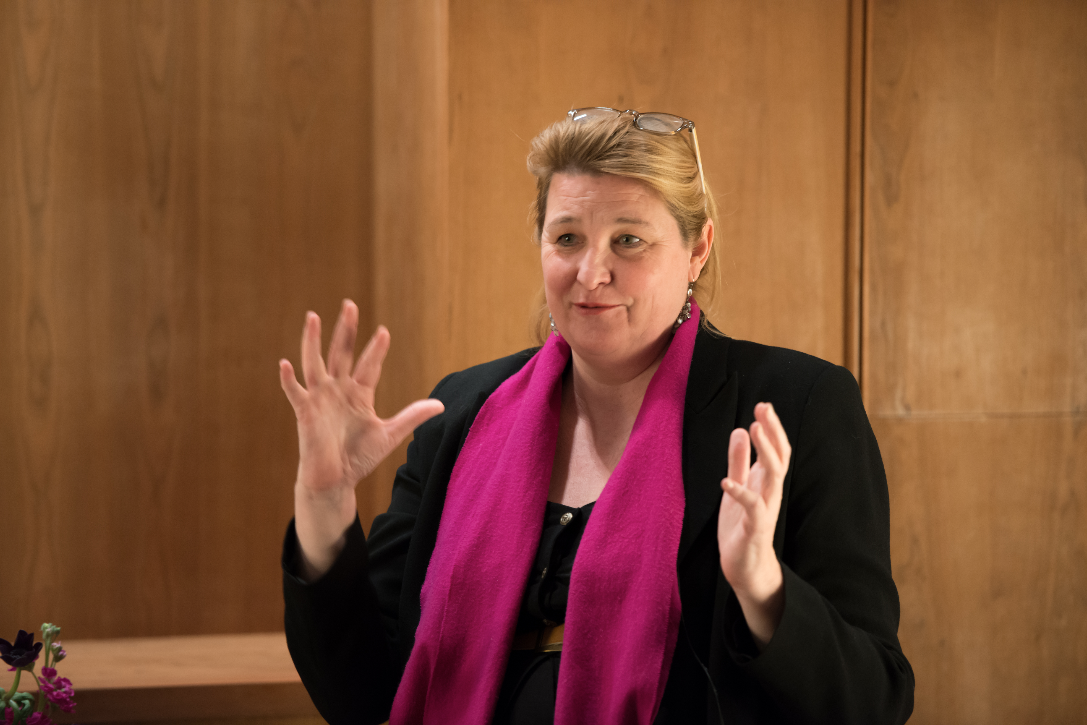
During her recent visit to the Mind & Life offices in Charlottesville, social neuroscientist Dr. Tania Singer spoke as much about the heart as the brain. Singer is the director of the Department of Social Neuroscience at the Max Planck Institute for Human Cognitive and Brain Sciences in Leipzig, Germany. She is on the board …
An Interview with Carol Worthman, Ph.D. Can you please give us a brief description of what you study? What I study with my lab is the interaction of culture and biology as they shape differential mental and physical health. Currently, we have a few studies around the world examining these interactions. For instance, we have …
For the past two decades, a small but growing number of scientists, philosophers, and scholars of religion have been building a unique community at the crossroads of their disciplines — a place where they can push the boundaries of traditional research to shine new light on fundamental questions about the human experience. What is this …
Each year, the Mind & Life Institute hosts the Summer Research Institute to bring together scholars, researchers, professionals and practitioners from a variety of fields who share an interest in contemplative research. The purpose of this program is to bring students, recent graduates, junior faculty and postdocs into conversation with established investigators in order to …
ORDER NOW Edited by Wendy Hasenkamp with Janna White (Yale University Press) ISBN: 9780300218084 In 2013, during a landmark Mind & Life dialogue at a Tibetan monastery in southern India, with an audience of thousands of monks and nuns, the Dalai Lama gathered with leading scientists, philosophers and monastics for in-depth discussions on the nature of …
What happens when an experience is described? Does the very effort to find words deepen practice, sharpen awareness, clarify an experience? Imagining a lens through which to deepen access to contemplative experience, these were among the questions that drove the conversation at a Mind & Life-funded Think Tank entitled the “PhenoTank,” held at the École …
To date, the traditions and techniques that have been most substantively researched in the field of contemplative science have largely derived from Buddhism and Buddhist-inspired movements. While there have been tremendous advances and developments due to this collaboration—indeed there would be no field without it—a natural consequence of this specific alliance is that insights from …