
Although the study of ethics in the Western academy has been dominatedfor the past several hundred years by two rationalist models, deontology andutilitarianism, there has been a resurgence of interest, especially in the past decade, in more embodied, practice-based approaches such as virtue ethics. In this talk, I will review evidence from various branches of …
Topic Archives:
ISCS 2014 – Master Lecture – Andrew Olendzki
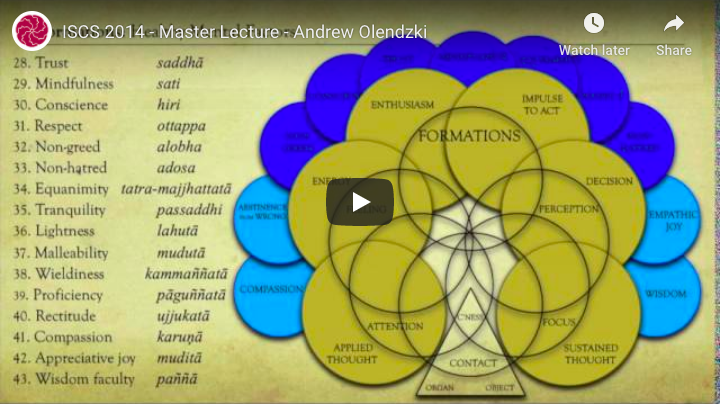
A Buddhist Contribution to Neurophenomenology
Master Lecture – A Buddhist Contribution to Neurophenomenology
The project of mapping the brain is making great progress in our time, butmapping the mind, in contrast, is still in its infancy. All people have an inner life, but the systematic exploration of this terrain, in a manner that can be useful to the scientific investigation of consciousness, is not well developed. Buddhists have …
Continue reading “Master Lecture – A Buddhist Contribution to Neurophenomenology”
ISCS 2014 – Master Lecture – Philip Zelazo
Fostering Resilience through Mindfulness in Childhood
Master Lecture – Contemplative Clinical Science
Overidentification with mental contents, excessive self-reference, and ceaseless discrepancy monitoring perpetuate symptom expression in physical and mental disorders. Mindfulness meditation, among other contemplative practices, enhances access to an alternative mode of processing that is less reliant on these strategies and instead promotes effective regulation through acceptant, present-oriented, and somatically informed states of mind. In recognition …
Continue reading “Master Lecture – Contemplative Clinical Science”
ISCS 2014 – Master Lecture – Zindel Segal
Contemplative Clinical Science
Concurrent Session 2 – Exploring Sleep Paralysis
The exploration of non-ordinary states of consciousness can have a potentially deep impact on our understanding of ourselves and the world. These states, however, are difficult to bring into a scientific discourse due to issues connected to their properties of reproducibility and ineffability. But these obstacles do not pose impossible challenges. Recently, there has been …
Continue reading “Concurrent Session 2 – Exploring Sleep Paralysis”
Concurrent Session 2 – The Social Side of Mindfulness: From Lab to Life
Traditional contemplative perspectives emphasize social benefits of mindfulnessand meditation, yet little research has investigated their social implications. Social situations involve distinct challenges for regulating affect, including the involvement of others’ emotions. This presentation briefly summarizes our prior lab-based work demonstrating that trait mindfulness predicts neural and behavioral responses consistent with efficient top-down attention to and …
Continue reading “Concurrent Session 2 – The Social Side of Mindfulness: From Lab to Life”
Concurrent Session 1 – Varela’s Promise: A Search for the Neural Correlates of the Phenomenological Reduction
In 1999, alongside Natalie Depraz and Pierre Vermersch, Francisco J. Varelaproposed a description of the structural dynamics of becoming aware. This account proceeds through the method of phenomenological reduction (or épochè). For Varela, the emergence of a unified cognitive moment relied upon dynamic links between functionally specialized regions of the brain. We propose an investigative …
Concurrent Session 1 – Can We Measure Mental Balance? Scientific and Contemplative Perspectives On Equanimity
In light of a growing interest in contemplative practices such as meditation, the emerging field of contemplative science has been challenged to describe and objectively measure how these practices affect health and well-being. We recently proposed that equanimity could serve as a measurable outcome of contemplative practices, both in basic science investigations and in clinical …